Keeping a fleet clean comes down to two options: send your vehicles to the wash, or bring the wash to them.
Both work. They just fit different vehicles and different days. Here's how mobile and brick-and-mortar fleet washing stack up, point by point, so the right mix is easy to build.
The Two Options, Side by Side
Here's what each one looks like in practice.
- Mobile washing: a crew comes to the yard or job site and washes vehicles right where they're parked.
- Brick-and-mortar washing: drivers take vehicles to a commercial wash location, whether in-bay or tunnel.
Compare on Convenience
Start with who has to do the driving.
- Mobile washing removes the trip entirely. Vehicles get cleaned in place, so no driver leaves the yard.
- Brick-and-mortar washing puts a wash wherever vehicles already are, with thousands of locations nationwide.
- Mobile washing runs on a set schedule; brick-and-mortar washing is there the moment a vehicle needs it.
- For vehicles that never sit still, brick-and-mortar washing is usually the faster call day to day.
Compare on Cost
Price is about more than the sticker on a single wash.
- Mobile washing trades travel time for a scheduled visit, which pays off when downtime is costly.
- Brick-and-mortar washing keeps per-wash pricing simple and skips paying for a crew to come out.
- Prices vary widely, one price at one location and a completely different price at another, so having more options helps.
- The real number is the total: the wash price plus the driver hours, fuel, and downtime around it.
Compare on Vehicle Type
Some vehicles just won't fit a standard wash, and that often makes the decision simple.
- Transit buses, box trucks, and heavy equipment usually need mobile washing or a specialized bay.
- Standard cars, vans, and pickups fit almost any brick-and-mortar wash.
- Mixed fleets rarely fit one method, which is why most end up using both.
- Mobile washing also reaches vehicles that can't safely leave a secure yard.
Compare on Tracking and Control
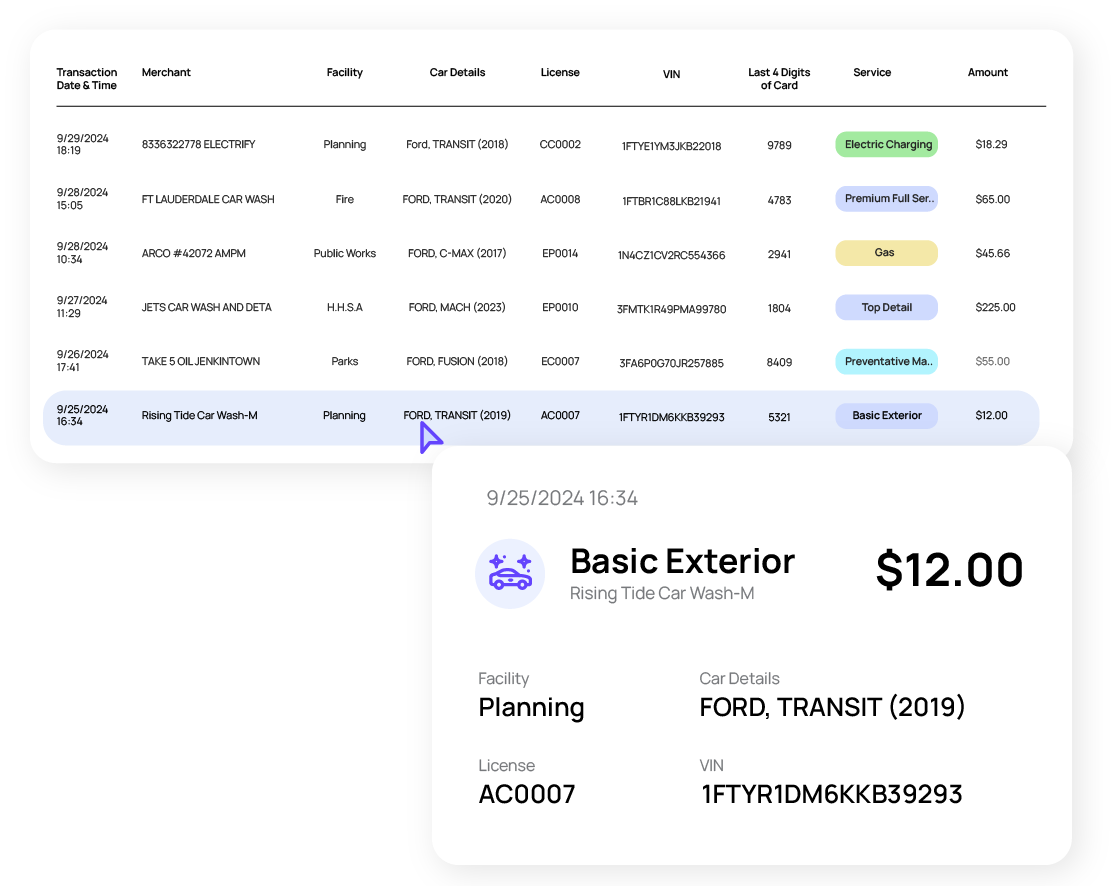
No matter how a vehicle gets washed, it's still important to see the spending and the activity.
- Centralized billing rolls mobile and brick-and-mortar washes into one itemized invoice.
- Simplified procurement replaces a pile of vendor relationships with one.
- Customizable spend controls set the rules by vehicle, vendor, or department.
- Built-in fraud monitoring flags unusual activity automatically.
How to Choose Between the Two
For most fleets, especially those that have outgrown a single wash location, the honest answer is both. The goal is to match each vehicle to the method that keeps it clean with the least lost time.
- Send big, parked, or specialized vehicles to mobile washing at the yard.
- Send everyday vehicles to brick-and-mortar wash locations near their routes.
- Use mobile washing for scheduled deep cleans and brick-and-mortar washing for quick washes in between.
- Keep both under one program so the choice never adds admin work.
Rynse connects fleets to both mobile wash providers and thousands of brick-and-mortar wash locations nationwide, all in one platform.
Frequently Asked Questions
What's the difference between mobile and brick-and-mortar fleet washing?
Mobile washing brings a wash crew to the vehicles, while brick-and-mortar washing sends vehicles to a commercial wash location.
Which one is cheaper?
It depends on the total cost. Brick-and-mortar washing often has simpler per-wash pricing, but mobile washing can cost less overall when it removes travel time and downtime.
Which is better for large vehicles?
Mobile washing usually wins for buses, box trucks, and heavy equipment that won't fit a standard wash bay.
Can Rynse cover both?
Yes. Rynse connects fleets to mobile providers and thousands of brick-and-mortar wash locations nationwide, with every wash tracked in one platform.
The Right Wash for Every Vehicle
Mobile washing and brick-and-mortar washing solve different problems, and the best programs lean on each where it fits.
Put them together in one platform and the day-to-day gets easy: every vehicle gets cleaned the simplest way, and it's all managed within one program.

Rynse Team